If you’ve been watching HPE over the last five years, you might have filed a few acquisitions under “interesting, but niche”: Zerto in 2021, OpsRamp in 2023, Morpheus Data in 2024. Individually they looked like point tools. Together, they’re something more deliberate — HPE has stitched them into a single, branded HPE CloudOps Software suite, and it’s aimed squarely at the cloud operating model most enterprises are trying to build.
This post is the map for the whole series. I’ll lay out what the suite actually is, how the three components fit, why HPE built it now, and — honestly — how it looks against the competition. No marketing gloss; just the shape of the thing so the deep-dives that follow have a frame to hang on.
Three verbs: orchestrate, observe, protect
The suite is easiest to understand as three jobs, one per component:
- Orchestrate — HPE Morpheus Software. Provisioning, self-service, automation, and policy-driven governance across VMware, HVM, public cloud, and Kubernetes. Morpheus comes in two forms that matter for this series: HPE Morpheus VM Essentials Software (the KVM-based HVM hypervisor and its Manager — the VMware-alternative layer) and HPE Morpheus Enterprise Software (the full hybrid-cloud management platform on top).
- Observe — HPE OpsRamp Software. Full-stack, hybrid observability and AIOps — discovery, monitoring, event correlation, and a GenAI operations copilot that reduces alert noise and surfaces root cause across on-prem, multi-cloud, and cloud-native estates.
- Protect — HPE Zerto Software. Continuous data protection, disaster-recovery orchestration, ransomware resilience, and workload mobility across on-prem and cloud.
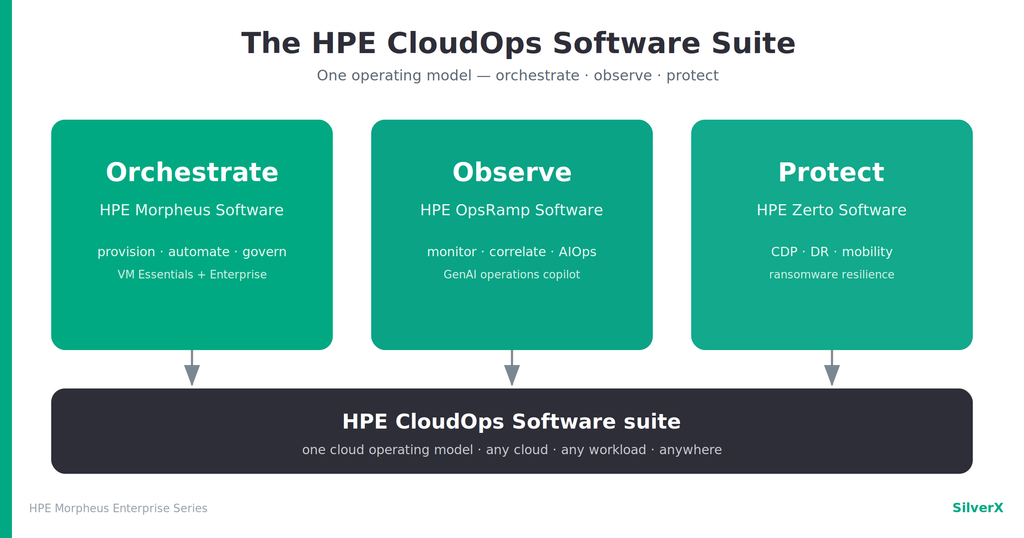
The pitch is that these three cover a workload’s whole lifecycle — plan and provision it, watch it in real time, and protect it — under one operating model, reducing tool sprawl and lock-in. Whether that integration is deep or still maturing is exactly the kind of thing this series will test component by component.
Why HPE built this now
Two forces converged.
The VMware/Broadcom disruption. Broadcom’s acquisition of VMware reshaped licensing and packaging in ways that sent a lot of enterprises shopping for alternatives — or at least leverage. HPE walked into that moment with a credible KVM-based hypervisor (HVM, via the Morpheus acquisition) and a per-socket licensing model pitched explicitly against per-core pricing on high-core-count CPUs. VM Essentials is the tip of that spear; the rest of the suite is the “and once you’re here, we can run your whole operation” follow-through.
The shift to hybrid + AI operations. Enterprises don’t run one cloud; they run several, plus on-prem, plus Kubernetes, increasingly plus AI workloads. That’s a monitoring and governance problem as much as a provisioning one — which is why OpsRamp (observability/AIOps) and Zerto (resilience) matter as much as Morpheus. HPE is betting that “operate everything from one model” beats “buy best-of-breed point tools and integrate them yourself.”
Worth noting HPE’s own framing: it still calls itself an infrastructure company, and all three CloudOps components came from infrastructure-adjacent acquisitions rather than a from-scratch software strategy. Read that how you like — it’s either pragmatic assembly or a coherent platform, and part of what this series will judge is which.
How it looks against the competition
Here’s the honest landscape. The suite doesn’t have one single competitor — it competes on three fronts at once, which is both its strength (one throat to choke) and its risk (specialists are strong in each lane).
| Layer | HPE CloudOps | The field it’s up against |
|---|---|---|
| Orchestrate | HPE Morpheus (VME + Enterprise) | Broadcom/VMware Cloud Foundation + Aria; Nutanix; Red Hat OpenShift Virtualization |
| Observe | HPE OpsRamp | Datadog; Dynatrace; ServiceNow ITOM; Grafana stacks |
| Protect | HPE Zerto | Veeam; Commvault; Rubrik; array-based replication |
The case for the suite: a single operating model across all three jobs, per-socket economics that undercut core-based virtualization licensing at high core counts, and a genuine multi-hypervisor story (manage VMware and HVM side by side, migrate at your own pace rather than rip-and-replace).
The case against, or at least the open questions: each specialist above is deep in its lane, and “integrated suite” only wins if the integration is real rather than three consoles with shared billing. That’s the single most important thing to verify as we go — and I’ll be testing it in the OpsRamp and Zerto tracks specifically, where the “works better together” claims are easiest to check.
I’m not here to tell you HPE wins or loses that comparison — that depends heavily on your estate, your VMware renewal math, and how much you value one vendor over best-of-breed. What I can do over this series is document how each piece actually works, so you can make that call with facts instead of slideware.
What this series will cover
This opener is the first of ~120 posts working methodically through the suite:
- HPE Morpheus VM Essentials Software — the HVM hypervisor, clustering, storage, HA, and VMware migration.
- HPE Morpheus Enterprise Software — multi-cloud provisioning, automation/IaC, governance, and SDN.
- HPE OpsRamp Software — observability, AIOps, and the GenAI operations copilot.
- HPE Zerto Software — continuous data protection, DR orchestration, and ransomware resilience.
Published three times a week, with a monthly “what I learned” field note threaded through. The goal is simple: by the end, this is the place you come to understand any part of the HPE CloudOps stack, correctly and currently.
Key takeaways
- HPE CloudOps Software suite = Morpheus + OpsRamp + Zerto, mapped to orchestrate / observe / protect.
- It exists because the VMware/Broadcom shake-up opened the door and hybrid + AI operations made single-model operation attractive.
- It competes on three fronts at once — strong as a unified suite, but each front has entrenched specialists.
- The claim worth testing, relentlessly, is whether the integration is real. That’s what this series is for.
What’s next
Next up: HPE CloudOps vs the Competition — a closer look at how the suite stacks against Broadcom/VMware Cloud Foundation, Nutanix, and the best-of-breed point tools, and where the per-socket economics actually change the math.
But I am not Undermining other good product in market, I intent to capture Broadcom, Nutanix, Redhat In coming dedicated series as well, and where they fits in enterprise story of bigger things.