Fourth post in the HPE Morpheus Enterprise track. E1.2 covered how the platform is built; this one places it against the incumbent most readers are running today.
Nobody evaluates a cloud management platform in a vacuum. They evaluate it against the one they already have, usually while a renewal quote sits open in another tab. Since the Broadcom acquisition reshaped VMware’s packaging, that conversation has become considerably less theoretical, and HPE Morpheus Enterprise Software (Morpheus Enterprise) shows up in it constantly.
So let’s do the comparison properly — capability by capability, then the part that matters more, which is the difference in operating model. I’ll be explicit about which side of each claim I can source: the Morpheus side is grounded in the documentation via HPE’s reference base; the VMware Aria side comes from the product as I’ve worked with it, and I’ve marked it accordingly. Aria’s packaging in particular has moved repeatedly — treat every Aria line here as against current Broadcom licensing.
The shape of the two things
The single biggest difference isn’t a feature. It’s that Aria is a suite and Morpheus is a product.
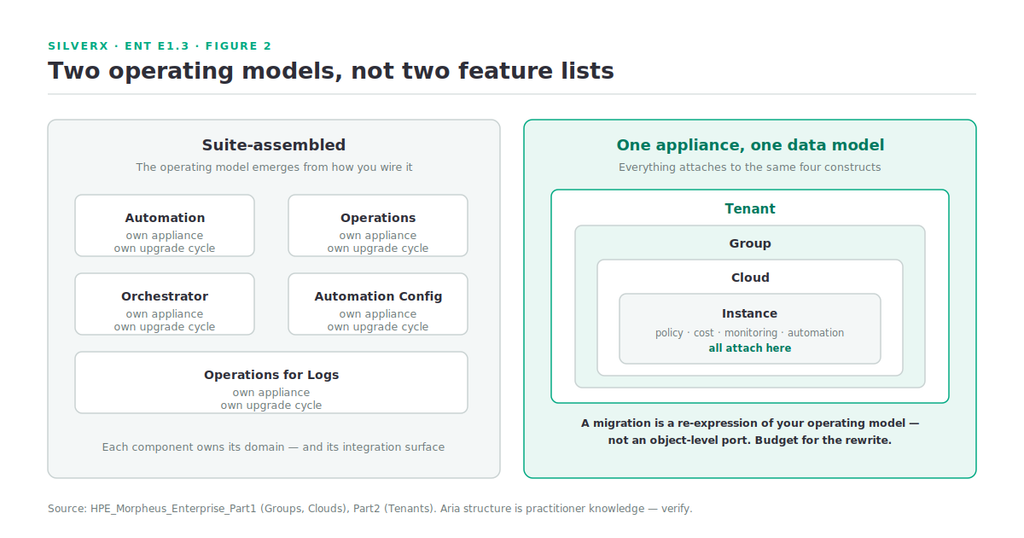
VMware Aria — formerly vRealize — is a family: Automation for provisioning and orchestration, Operations for monitoring and capacity, Automation Orchestrator for workflow, Automation Config for configuration management, Logs for log analytics, and so on. Each has its own appliance, its own upgrade cycle, and its own integration surface. Building the operating model means assembling them.
Morpheus Enterprise is one Debian/RPM package that installs an appliance containing all four service tiers — application, transactional database, non-transactional database, and message — with morpheus reconfigure installing only what you haven’t externalised in /etc/morpheus/morpheus.rb. Provisioning, automation, policy, monitoring, logging, costing, and self-service are functions of that one product, not separate purchases.
That’s a genuine architectural difference with real consequences in both directions, and it’s the frame for everything below.
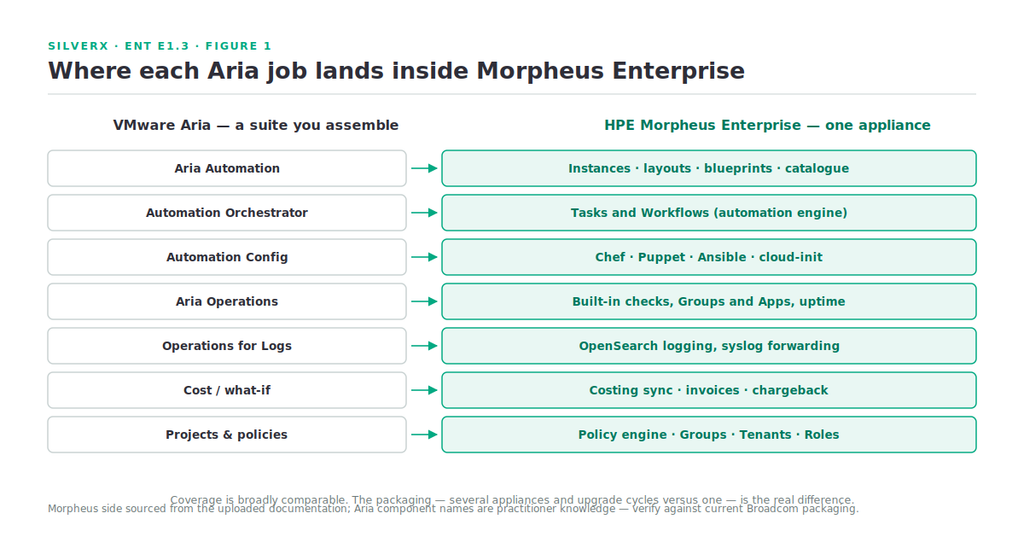
Capability by capability
| Capability | VMware Aria | HPE Morpheus Enterprise |
|---|---|---|
| Provisioning & self-service | Aria Automation — catalogue, blueprints, cloud templates | Instances, layouts, blueprints, self-service catalogue, XaaS instance types |
| Workflow orchestration | Aria Automation Orchestrator (a distinct product with its own language) | Tasks and Workflows in the automation engine; shell, Python, Ansible, Terraform |
| Config management | Aria Automation Config (SaltStack lineage) | Chef, Puppet, Ansible, Ansible Tower integrations; cloud-init user data |
| IaC | Cloud templates; Terraform via integration | First-class Terraform and Ansible; Git-backed IaC with drift state |
| Monitoring | Aria Operations — deep vSphere-native analytics | Built-in checks on everything provisioned, hierarchical Groups/Apps, uptime with redundancy factored in |
| Log analytics | Aria Operations for Logs | OpenSearch-backed logging, 7-day default retention, per-host syslog forwarding |
| Cost | Aria Operations cost/what-if | Costing sync, invoices, chargeback/showback, cost estimator, markup |
| Governance | Projects, policies, approvals | Policy engine — Max Resources quotas, naming, placement, approvals, scoped to Cloud/Group/Role/User/Tenant |
| Multi-tenancy | Projects and org constructs | Primary / parent / subtenant hierarchy with white-labelling |
| Networking | NSX integration | SDN plugin, HVM Network Plugin, Aruba CX, Cisco ACI 3.x–5.x |
| Non-VMware estate | Supported, but vSphere is home turf | 30+ cloud types including Nutanix, SCVMM, Hyper-V, XenServer, OpenStack, Kubernetes, bare metal |
The honest summary: capability coverage is broadly comparable. Anyone telling you Morpheus can’t do what Aria does hasn’t looked recently, and anyone telling you it’s a drop-in replacement hasn’t done a migration.
Where Morpheus is genuinely stronger
Heterogeneity is the design centre, not a plugin. Aria is superb on vSphere — the depth of Operations against vSphere metrics is real and hard to match. But Morpheus was built for a world where vCenter is one cloud among many. The supported cloud type list runs from Amazon, Azure and Google through Nutanix, OpenStack, SCVMM, Hyper-V and XenServer to generic PXE and bare-metal types for HPE, Dell, Supermicro and UCS hardware. If your estate is genuinely mixed, that difference compounds daily.
Fewer moving parts. One appliance, one upgrade, one licence, one support case. If you’ve ever coordinated an Aria suite upgrade across four appliances and their interdependencies, this lands.
Multi-tenancy is first-class. The primary/parent/subtenant hierarchy with per-tenant permission ceilings and white-labelling is built for service providers and large enterprises delegating to business units. It’s not bolted on.
The migration path from the hypervisor layer is coherent. Because HPE Morpheus VM Essentials Software and Morpheus Enterprise are the same product image with different licences, you can land the management layer on your existing vCenter estate first and move hypervisors later — or never. That’s a materially lower-risk sequence than “replace the CMP and the hypervisor at once.”
Where VMware is genuinely stronger
I’d rather write this section than have you find it out yourself.
Maturity and vSphere depth. Aria Operations’ vSphere analytics, capacity modelling and what-if planning have had many years of engineering aimed at one hypervisor. If your estate is 100% vSphere and stays that way, that depth is worth something real.
Ecosystem and skills. The pool of engineers who already know vRealize/Aria is large. The pool who know Morpheus is smaller and growing. Factor training into the business case honestly — this is usually a bigger line item than people budget.
NSX integration. If you’re deeply invested in NSX, the native integration is tighter than any third-party CMP’s.
Content and blueprint libraries. Years of accumulated community blueprints and workflows don’t transfer. Whatever you’ve built in Orchestrator is a rewrite, not a migration.
The operating-model difference
This is the part that decides whether a migration goes well, and it isn’t a feature comparison.
Aria’s model tends to be suite-assembled: each component owns its domain, and the operating model emerges from how you wire them together. Morpheus’s model is appliance-centric: the constructs — Clouds, Groups, Instances, Tenants — are one data model, and everything (policy, cost, monitoring, automation) attaches to that model.
Practically, that means a Morpheus migration is not a like-for-like port of Aria objects. It’s a re-expression of your operating model in a different vocabulary. Projects become some combination of Groups, Tenants and Roles depending on what they were actually being used for. Blueprints become instance types, layouts and workflows. Orchestrator workflows become Tasks and Workflows, usually rewritten rather than converted.
Gotchas and caveats
Don’t run the comparison on features alone. Both platforms will tick most boxes on a spreadsheet. The differentiators are heterogeneity, packaging, tenancy, and the cost of the skills you already have.
Count what’s in the box. Morpheus includes monitoring, logging, costing and policy. If your Aria comparison covers Automation only, you’re comparing a subset of one against the whole of the other. Build the comparison on your full current spend across the suite.
The lab licence will mislead your PoC. Morpheus’s free lab licence is time-unlimited but capped at 25 managed and discovered workloads. Point it at a real vCenter and it will hit that ceiling immediately — which is a licensing artefact, not a scale finding.
Terraform version pinning. When Morpheus handles the Terraform installation itself it uses version 1.5.5 for licensing reasons. If your existing IaC assumes a later version, plan to manage the Terraform install yourself.
Nothing here is a pricing comparison. I’ve deliberately kept commercial terms out. Both vendors’ licensing has moved recently, and any number I wrote would be wrong by the time you read it. Get both quotes, scope them to the same capability set, and include the training line.
Key takeaways
- Aria is a suite; Morpheus is a product. That packaging difference drives most of the others.
- Capability coverage is broadly comparable — the differentiators sit elsewhere.
- Morpheus wins on heterogeneous estates, operational simplicity, and multi-tenancy.
- VMware wins on vSphere depth, ecosystem maturity, available skills, and NSX.
- A migration is a re-expression of your operating model, not an object-level port. Budget for the rewrite of Orchestrator content.
- Compare the whole suite spend against Morpheus, since monitoring, logging, costing and policy are in the box.
What’s next
Next in this track: E1.4 — Deploying Morpheus Enterprise. From base requirements and appliance sizing through the actual install, SSL certificates, offline installations behind a proxy, and the pre-flight checks that decide whether your appliance comes up clean the first time.